


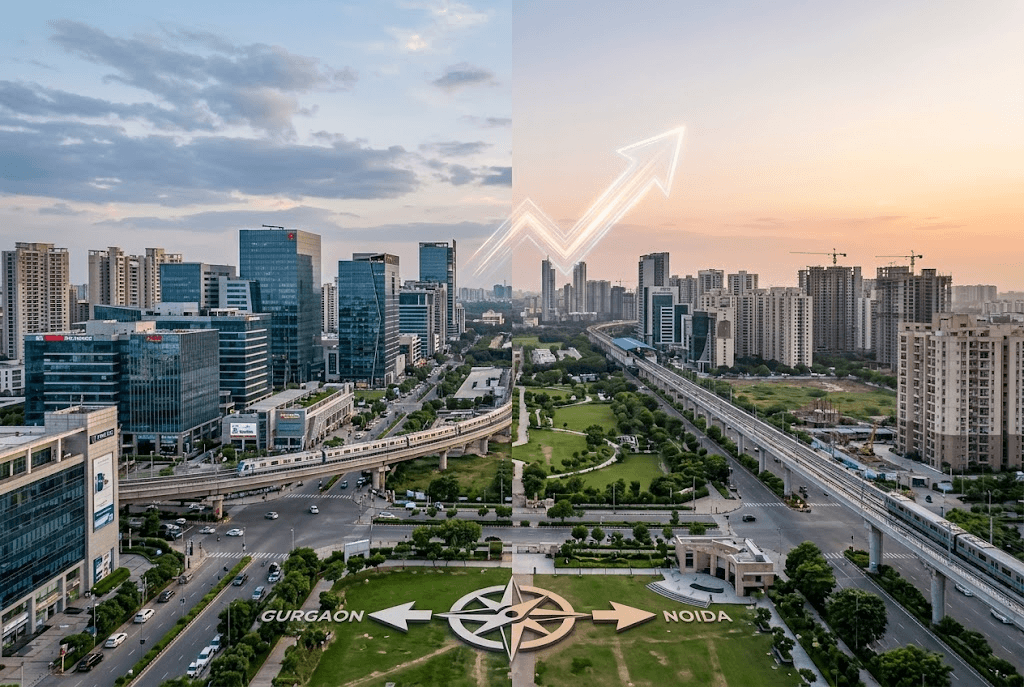
If you ask anyone who has been looking at estate in the National Capital Region for a while, they will almost always ask the same question: Gurgaon or Noida? Gurgaon has earned a name as the place for offices and high‑end homes in North India. Noida has made a name for planned infrastructure, lower prices, and a growing set of business zones. In 2026, Noida received a headline when the first phase of its international airport opened on March 28. Neither city is a winner. Which one suits you better depends on your budget, how you plan to hold the property, how much rent you want, and what you really want to achieve.
In this guide, I compare Gurgaon and Noida by looking at prices, rental returns, roads, and transport, how much the property value grows, and how suitable each city is for investors. Below are the numbers for each city.
Quick Answer
I do not see a winner. The two cities serve different investment goals. Gurgaon apartment asking prices are around ₹14,850/sq ft based on the cited 2026 benchmark. Square Yards data from August 2026 says Noida’s ready‑to‑move homes average about ₹9,100 per foot, though prices change a lot by project and building stage. ANAROCK’s Q2 2026 data shows rental returns of about 4.3 % for Gurgaon and 3.9 % for Noida. Noida also has an infrastructure boost: the international airport at Jewar. Phase I opened on March 28, 2026. Commercial flights began on June 15, 2026. If you want income, a mature market, and premium homes, Gurgaon may suit you better. If you want an entry price and long‑term growth driven by new infrastructure, Noida may suit you better.
Gurgaon has become one of NCR’s most established real estate markets, supported by a large corporate base, strong demand for premium housing, and major infrastructure corridors. Global companies, startups, financial institutions, and professional services firms continue to create employment, which in turn supports demand for both homes and rental properties. Gurgaon has a strong base of large companies, global firms, startups, and financial institutions. These businesses create jobs and keep demand for homes strong, especially among working professionals and senior executives. This happens without depending on one building or project. Key growth corridors include Dwarka Expressway, Dwarka, Golf Course Road, Golf Course Extension Road, Southern Peripheral Road (SPR), New Gurgaon, and Sohna Road. The need for homes is mostly because of workers from companies, rich people looking for good houses, NRI buyers, and international professionals and businesses that rent space. This mix has helped keep the housing market strong property values going up and people selling homes easily.
Noida Real Estate Market
Noida has changed a lot from being a cheaper option than Gurgaon. Its planned areas, more jobs, and big construction projects have made it a separate place to invest within the NCR region.
Major investment corridors: Noida Expressway, Greater Noida, Sector 150, Yamuna Expressway, the Jewar Airport region, Noida Extension.
The main advantage is straightforward: buyers can still enter Noida at a lower price point while gaining exposure to a region where roads, transport links, commercial activity and employment hubs are expanding. The most important of these is the Jewar Airport. It brings a new airport and better transportation to the whole area.
At a Glance
| Factor | Gurgaon | Noida |
| Avg. asking price benchmark (2026) | ~₹14,850/sq ft | ~₹9,100/sq ft (ready-to-move) |
| Illustrative premium locality benchmark | ~₹21,350/sq ft (Golf Course Road) | ~₹12,200/sq ft average (Sector 150 average) |
| Rental yield benchmark (Q2 2026) | ~4.3% gross | ~3.9% gross |
| Market maturity | Established, mature | Developing, infrastructure-led |
| Key 2026 catalyst | Corporate ecosystem + infrastructure | Noida International Airport (Jewar) |
| Typical investor focus | Rental income, luxury, resale liquidity | Affordability, long-term growth, first-time buyers |
Rental yields differ a lot depending on the micro‑market, the type of property, the size of the unit, and how much the property costs. I view these numbers as market benchmarks, not guarantees of returns.
The figures are simply industry benchmarks, not set transaction prices. Always check the project‑level prices before making a decision.
Infrastructure Comparison
Infrastructure remains one of the drivers of property appreciation in both cities. However, the two markets are at different stages of their infrastructure cycle.
Gurgaon already has a transportation network: Dwarka Expressway, NH‑48, the growing Delhi–Mumbai Expressway connectivity, Rapid Metro, SPR, CPR, and direct proximity to IGI Airport. This maturity is why the city attracts both end‑users and tenants who want infrastructure that is already delivered, not only promised.
By contrast, Noida’s growth story is largely driven by infrastructure. Key developments are Noida International Airport, the Noida–Greater Noida Expressway, the Yamuna Expressway, the Aqua Metro Line, Film City and a growing set of logistics parks and industrial corridors. The airport stands out: Phase I was inaugurated on March 28, 2026. Commercial flight operations began on June 15, 2026. This is a concrete delivered milestone, not a proposal still waiting for approvals.
The prices in Gurgaon stay high because the locations are premium, land supply is tight, corporate demand is steady, and many luxury projects are in the works. According to Square Yards March 2026 data, the average price in Gurgaon is ₹14,850 per square foot. The road called Golf Course Road has an average asking price of about ₹21,350 per square foot. Gurgaon requires a higher initial investment, but established micro-markets generally offer stronger resale liquidity.
Noida offers a lower entry price, bigger apartments for the same amount of money, and more planned sectors. Square Yards August 2026 data shows ready‑to‑move projects cost about ₹9,100 per foot. Projects that are already occupied cost about ₹8,750 per foot. New‑launch projects cost a lot more, close to ₹14,850 per foot, showing that Noida has a wide price spread depending on the stage of the project. Premium areas such as Sector 150 cost ₹13,000 to ₹18,000 per square foot, still below Gurgaon’s highest prices.
The main takeaway is simple: Noida remains more affordable than Gurgaon across many comparable segments. However, affordability is not uniform. New-launch projects in premium micro-markets can already be priced close to Gurgaon’s average.
Rental Income Comparison
Rental demand is where the two cities diverge most clearly.
Gurgaon’s rental demand is supported by IT companies, consulting firms, financial services, MNCs, and a large base of corporate professionals and expats. Premium locations tend to maintain strong occupancy. Most people say the rental yields in Gurgaon stay between 3.5% and 5% because there are many corporate tenants. If you are looking for where to rent, check out Golf Course Road, DLF Phase 1–5 Cyber City, Sector 42, Sector 56, and Dwarka Expressway.
In Noida, the demand for rentals comes from IT parks, schools, manufacturing plants, corporate offices, and all the new businesses near the Yamuna Expressway and Jewar Airport region. The rental yields in Noida are usually 3% to 4%. Some of the areas for rentals are Sector 137, Sector 150, Sector 93, Sector 75, and Greater Noida West.
Please remember that these numbers are not a promise for any house. Your actual rental yield will change based on the building, the size of the unit, how much rent you can actually get, and how much you paid for the property. Do not just look at the city average.
Capital Appreciation: Gurgaon vs Noida
Recent market data shows residential price appreciation in both markets. Between 2019 and Q2 2026, average residential prices increased by 125% in Noida and 117% in Gurgaon. In Q2 2026, average capital values were around ₹10,780 per foot in Noida and ₹13,350 per square foot in Gurgaon.
The numbers highlight a difference: Noida has recorded a slightly higher percentage appreciation while Gurgaon continues to command a higher absolute price level. However, historical appreciation does not guarantee returns. Micro-location, project quality, entry price, employment growth, rental demand, and infrastructure connectivity remain factors when evaluating future potential.
Bottom line: Historically, Noida has combined an entry price with strong residential appreciation, while Gurgaon continues to command higher prices due to its established employment base, premium housing demand, and market maturity.
Luxury vs. Affordable Investment
If luxury real estate is the priority, Gurgaon has a more established premium housing market. Premium projects from developers keep attracting wealthy Indians and overseas Indians because they offer high‑quality amenities, a mature business ecosystem, higher rental demand and a richer resale market for premium homes.
If your budget is comparatively limited, Noida might be the choice for investors who want lower entry costs and long‑term growth driven by infrastructure. Smaller investment amounts and a wider range of sectors can let investors tap into infrastructure‑driven growth at a lower entry point than in some established Gurgaon micro‑markets. Future price gains will depend on the quality of the project, how well the infrastructure is used, job growth, and the starting valuation.
Gurgaon vs Noida: Investment Decision by Goal
| Investment goal | Better-suited market | Why |
| Rental income | Gurgaon | Higher Q2 2026 rental-yield benchmark |
| Lower entry price | Noida | Lower ready-to-move benchmark |
| Luxury housing | Gurgaon | Deeper premium housing market |
| Historical appreciation | Noida | 125% vs 117% from 2019 to Q2 2026 |
| Mature market | Gurgaon | Established corporate and employment ecosystem |
| Infrastructure-led growth | Noida | Airport, expressways, and expanding employment zones |
| First-time buyer | Noida | A wider range of comparatively lower-ticket housing |
| Premium commercial | Gurgaon | Strong corporate office ecosystem |
Gurgaon vs Noida: Which Is Better for Property Investment in 2026?
Choose Gurgaon if your priority is rental income, premium housing, market maturity and corporate-driven demand.
Choose Noida if your priority is lower entry cost, infrastructure-led growth and a longer investment horizon.
Based on ANAROCK’s 2019–Q2 2026 data, Noida recorded a higher percentage capital appreciation at 125%, compared with 117% for Gurgaon, while Gurgaon had the higher Q2 2026 gross rental yield at 4.3%, compared with 3.9% in Noida.
Commercial Property Investment
Both cities perform well here, just in different lanes.
Gurgaon is strongest for Grade-A offices, retail, high-end commercial assets, and corporate leasing. Noida may be better suited to IT parks, business parks, retail developments, industrial investment, and warehousing, much of it now getting an added boost from Jewar’s cargo and logistics potential.
Who Should Invest in Gurgaon?
Choose Gurgaon if you want premium property, rental income, a mature market, strong corporate-driven demand, and relatively established resale liquidity.
Who Should Invest in Noida?
Choose Noida if your budget is moderate, you’re investing for long-term appreciation rather than immediate yield, you want exposure to infrastructure-led growth, you’re a first-time real estate investor, or you’d rather have a larger home for less money upfront.
Expert Take from KMA Global Property
The decision should never rest on the city name alone. Focus instead on micro-location, builder reputation, connectivity, upcoming infrastructure, legal approvals, rental demand, and future employment hubs. Two properties in the same city can generate very different returns depending on these factors.
For any investment decision, investors should compare the specific project, developer, location, acquisition cost, rental potential, and applicable charges rather than relying only on city-level averages.
Key Risks to Consider
Gurgaon
- Higher entry price
- Higher acquisition cost
- Premium valuations in established micro-markets
- Project-level supply differences
- Rental yield varies significantly by property
Noida
- Greater variation between established and emerging sectors
- Infrastructure-led appreciation is not guaranteed
- Airport impact will differ by micro-market
- Project quality and occupancy can vary significantly
- New-launch pricing can already be relatively high in premium sectors
Frequently Asked Questions
Is Gurgaon better than Noida for buying property?
Gurgaon tends to suit high-end investment and rental income, while Noida is more affordable and currently has stronger infrastructure-led growth potential, particularly following the March 2026 opening of Noida International Airport.
Which city has better rental yields?
Gurgaon generally offers higher gross rental yields, commonly cited in the 3.5–5% range, supported by a large corporate and expat tenant base. Noida’s yields typically run somewhat lower, around 3–4%.
Is Noida a good investment for 2026?
Noida remains an important market to evaluate in 2026, particularly for investors focused on infrastructure-led growth. Noida International Airport’s Phase 1 was inaugurated on March 28, 2026, with commercial flight operations commencing on June 15, 2026. Alongside the expanding expressway and metro networks, as well as growing commercial activity, these developments could support Noida’s long-term real estate potential.
What is the best city for first-time home buyers?
First-timers tend to gravitate to Noida due to its average entry price and larger variety of housing options for different budgets.
Which city is best for capital appreciation?
Recent market data shows that Noida recorded 125% residential price appreciation between 2019 and Q2 2026 compared with around 117% in Gurgaon. However, historical appreciation does not guarantee returns, and performance can vary significantly by micro-market and project.
Is Gurgaon or Noida better for long-term investment?
While both have long-term opportunities, they are suitable for different types of investors. There are prospects for the future in both. Gurgaon is perfect for those looking for end residential and commercial properties with a strong rental market; Noida is ideal for those looking for lower entry points plus infrastructure-driven appreciation.
Where is capital appreciation stronger — Gurgaon or Noida?
It comes down to the micro-market more than the city. Gurgaon has delivered appreciation in corridors like Dwarka Expressway and Golf Course Extension Road, while Noida has seen strong growth around Noida Expressway, Sector 150, and the Jewar Airport belt.
Which city is best for an NRI buyer?
Gurgaon has a high-end NRI presence today backed by global corporates and an established luxury housing market. Noida is drawing a growing share of NRI interest from investors chasing growth at a lower entry cost.
Is Gurgaon more expensive than Noida?
Yes, Gurgaon generally commands residential prices, particularly in premium micro-markets such as Golf Course Road and established luxury corridors. However, the difference varies considerably by sector, project, property type, and construction stage.
Is Noida still worth investing in after the 125% appreciation?
Noidas 125% appreciation from 2019 to Q2 2026 reflects performance, not a forecast. Investors should evaluate entry prices, rental demand, infrastructure connectivity, project quality, and the specific micro-market rather than assuming the historical growth rate will continue.
Conclusion
Investors should evaluate entry prices, rental demand, infrastructure connectivity, project quality, and the specific micro-market rather than assuming the historical growth rate will continue.
The better question isn’t “which city is better?” It’s “Which city actually fits what I’m trying to achieve?” With the right project selection and proper due diligence, both markets can offer investment opportunities when the right project, entry price, and micro-location are selected.
Sources & Methodology
According to Square Yards’ 2026 market data, Gurgaon’s average asking price is ₹14,850 per sq ft., while Golf Course Road averages around ₹21,350 per sq ft. Yield and historical capital appreciation figures for Noida and Gurgaon are based on ANAROCK Research data covering 2019 to Q2 2026. Infrastructure information relating to Noida International Airport has been cross-checked against airport and Government of India sources.
About This Guide
This guide was. Reviewed by the KMA Global Property Research Team in August 2026. Price benchmarks are drawn from Square Yards 2026 locality data (Gurgaon average ~₹14,850/sq ft as of March 2026; Noida average ~₹9,100/sq ft for ready-to-move inventory as of August 2026). Rental yield ranges reflect figures commonly cited across industry commentary and should be treated as directional estimates rather than guaranteed returns. The Noida International Airport inauguration date (March 28 2026) is confirmed via government sources.
Disclaimer: Real estate prices, rental yields and infrastructure timelines change continuously. Independently verify project pricing, RERA/UP-RERA registration, developer track record, and applicable charges before making an investment decision. This article is for informational purposes only and does not constitute financial or investment advice. Past appreciation does not guarantee returns.
For project-level decisions, investors should compare pricing, developer track record, RERA registration, rental potential, location, connectivity, and total acquisition costs before making a decision.