


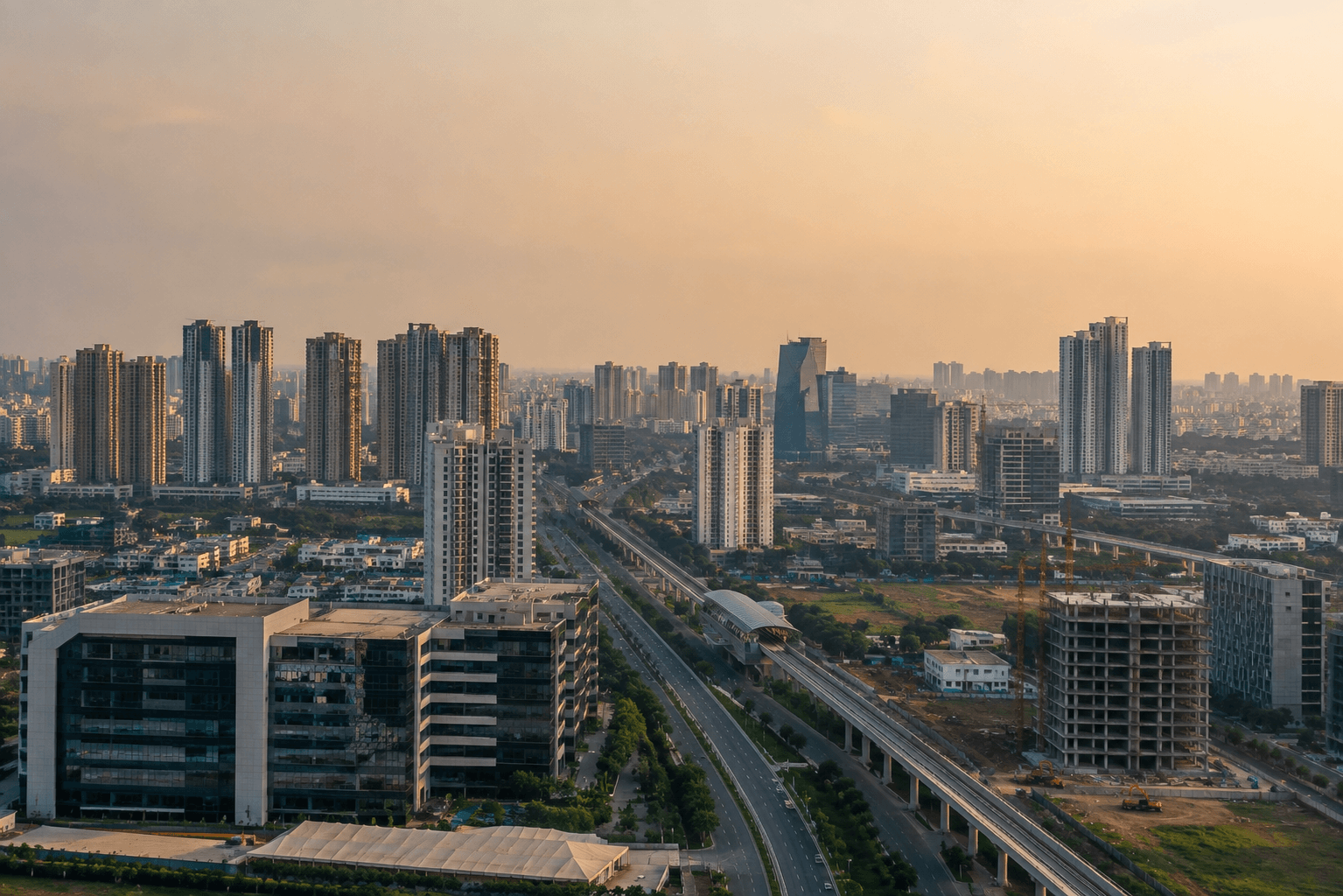
Key Takeaways
- Gurgaon does not currently show the characteristics of a city-wide real estate bubble.
- Strong employment growth, infrastructure development, and end-user demand continue to support prices.
- Some micro-markets have appreciated unusually quickly and deserve closer scrutiny.
- Residential rental yields remain modest at around 2–3%.
- Buyers should evaluate individual projects rather than relying on city-wide trends.
The Gurgaon property market in 2026 reflects a mix of strong fundamentals, higher valuations, and selective risks across micro-markets. Every time a Gurgaon micro-market posts a headline-grabbing price jump, the same question resurfaces on investor forums and WhatsApp groups: is this growth real, or is Gurgaon just the next market waiting to correct hard? A balanced answer requires looking beyond recent price growth and examining the fundamentals supporting demand, along with the risks that could affect future performance.
This analysis examines what constitutes a real estate bubble and evaluates Gurgaon against those criteria, and crucially, does not ignore the more complex aspects of the story that lend themselves to a “this is normal” narrative. Whether you’re considering purchase, hold, or wait decisions, you need the uncomfortable data points just as much as the reassuring ones.
Quick Answer
Gurgaon does not currently show signs of a city-wide real estate bubble in 2026. Strong employment growth, infrastructure expansion, and end-user demand continue to support the market. However, some micro-markets have experienced unusually rapid appreciation, rental yields remain modest, and buyers should evaluate individual projects rather than the city as a whole.
| Metric | Current Status |
| Bubble Risk | Low city-wide |
| End-user Demand | Strong |
| Rental Yield | Moderate (2–3%) |
| Infrastructure | Expanding |
| Oversupply | Limited |
| Investment Horizon | 5–10 years |
What Actually Defines a Real Estate Bubble?
A property bubble forms when prices rise significantly beyond what underlying fundamentals such as income levels, rental returns, and genuine housing demand can justify. The usual warning signs include:
- Prices rising with little real buyer interest behind them
- A large share of buyers purchasing purely to flip, not to live in or rent out
- Housing surplus relative to actual demand
- Rental yields too low to justify the purchase price on fundamentals alone
- Deteriorating affordability relative to local incomes
- Sharp corrections once speculative buyers exit simultaneously
Most historical property bubbles from the US in 2008 to parts of China more recently showed several of these at once. The relevant question for Gurgaon isn’t whether prices have risen fast (they have), but whether that rise is backed by real demand or mostly by speculation.
Does Gurgaon Show Bubble Characteristics Today?
| Indicator | Healthy Market | Bubble Market | Gurgaon (2026) |
| End-user demand | High | Low | High |
| Rental demand | Strong | Weak | Strong, but yields modest |
| Infrastructure | Expanding | Weak/stagnant | Expanding |
| Speculative buying | Moderate | Very high | Moderate, higher in select sectors |
| Supply | Balanced | Oversupplied | Broadly balanced |
| Price volatility | Low-moderate | High, sharp reversals | Moderate; one correction already seen in 2025 |
City-wide, Gurgaon lands closer to “healthy” than “bubble” on most indicators. But two rows in that table deserve more scrutiny than a simple checkmark, so these indicators require closer examination rather than a simple conclusion.
Are Gurgaon Rental Yields Good in 2026?
Residential rental yields in Gurgaon are generally estimated to range between 2% and 3% across many residential segments, according to industry research published by organizations such as Knight Frank, JLL, CBRE, and ANAROCK. While these yields are relatively modest compared to the city’s long-term capital appreciation potential, and lower than those typically seen in many commercial real estate assets, they do not, by themselves, indicate a property bubble. Investors focused on rental income should assess location-specific rental demand, vacancy rates, maintenance costs, and future growth prospects before making an investment decision.
Low rental yield alone doesn’t prove a bubble; it’s normal in high-appreciation markets, where investors accept lower current income in exchange for capital growth. But it does mean Gurgaon residential property isn’t currently a strong pure income play, and any analysis that leans entirely on “rental demand is strong” without mentioning the yield number is giving you half the picture. If your primary goal is rental income rather than capital appreciation, rental yield should be one of the first metrics you evaluate, along with vacancy risk, maintenance costs, and future demand.
Did Gurgaon Property Prices Correct Before 2026?
The idea that Gurgaon property prices only move upward does not fully reflect recent market behaviour. After significant appreciation between 2021 and 2024, some residential segments experienced price moderation during 2025 as buyers became more selective and affordability pressures increased.
The correction was not uniform across Gurgaon. Established premium locations, infrastructure-led corridors, and high-demand projects showed greater resilience, while some rapidly appreciated pockets saw more noticeable price adjustments.
This moderation does not indicate a market collapse. Instead, it highlights that Gurgaon has entered a more mature phase where valuations are being tested against fundamentals such as employment growth, infrastructure delivery, supply discipline, and genuine end-user demand. A market capable of absorbing slower growth or limited corrections is different from one driven purely by speculative momentum.
Why Have Gurgaon Property Prices Increased?
The rise in prices over the past five years can be attributed to several real (rather than speculative) factors.
Infrastructure Expansion
The connectivity upgrade has significantly altered the commutable area of Gurgaon and consequently, also the demand for it, which is the fastest among all factors. Key developments include:
- The partly operational and direct link between Gurgaon and Delhi and the airport, the Dwarka Expressway.
- Southern Peripheral Road (SPR), progressing steadily and opening up commercial and residential corridors between Sohna Road and NH-48
- Planned Metro Phase 4 expansion and continued Rapid Metro connectivity improvements
- The proposed Global City project, expected to add a new commercial and residential hub
- Delhi-Mumbai Expressway connectivity, improving long-distance access
Employment Growth
Gurgaon remains one of India’s leading corporate hubs, with offices of multinational companies, technology firms, consulting firms, financial institutions, and Global Capability Centres. This results in a continuous, real demand for housing by professionals relocating for employment, as opposed to speculative buyers, who look to resell the home within months.
Limited Premium Supply
In general, developers have introduced premium inventory piecemeal, rather than introducing the market on a large scale, which has limited supply in key luxury corridors and allowed for a real, although limited, increase in prices.
Rising Construction Costs
Material inflation, labour costs, and higher construction and compliance standards have pushed up development costs industry-wide, which shows up directly in new-launch pricing. Some of today’s higher prices simply reflect what it costs to build now, not speculative markup.
Which Gurgaon Areas Offer the Best Long-Term Investment Potential?
Not every part of Gurgaon tells the same story, and lumping them together is where a lot of bubble commentary goes wrong.
Corridors with strong appreciation backed by fundamentals:
- Dwarka Expressway: Driven by genuinely completed connectivity infrastructure
- Southern Peripheral Road (SPR): Commercial growth and improving connectivity
- New Gurgaon: Still offers relatively affordable entry points with room to grow
- Golf Course Extension Road: Sustained premium demand, though pricing is no longer cheap
Gurgaon Real Estate Outlook by Corridor (2026)
| Corridor | Market View | Key Driver |
| Dwarka Expressway | Growth corridor | Connectivity + new development |
| SPR | High-growth zone | Commercial expansion |
| Golf Course Extension Road | Premium established market | Luxury demand |
| New Gurgaon | Value growth corridor | Affordability + infrastructure |
| Golf Course Road | Mature premium market | Corporate demand |
Pockets worth more caution:
Some Gurgaon micro-markets have significantly outperformed the city average due to infrastructure development, premium launches, and strong buyer demand. Such localized price movements deserve project-level evaluation rather than broad city-wide conclusions. Numbers at that scale, concentrated in a short window and a narrow location, are exactly the kind of localized pattern that deserves more scrutiny than city-wide averages provide. This doesn’t mean those areas are guaranteed to correct, but it does mean broad statements like “Gurgaon isn’t a bubble” shouldn’t be applied uncritically to every single sector inside the city.
Who Is Buying Gurgaon Property? Demand vs. Speculation
The composition of buyers tells you more about market health than price charts alone. Gurgaon’s current demand base includes:
- End-users buying homes for their own families
- NRIs investing for long-term wealth creation
- Professionals relocating for work
- Buy-to-let investors and landlords
- Business owners and entrepreneurs buying premium residential property
A market dominated by short-term flippers tends to be fragile; everyone tries to exit at once when sentiment shifts. A market with this broader mix of end-users, NRIs and long-term investors tends to be more resilient, because most of these buyers aren’t trying to sell within 12–18 months regardless of what prices do next.
Risks Every Investor Should Actually Weigh
None of the following necessarily signals a bubble, but ignoring them isn’t bullish; it’s just incomplete analysis:
- High entry prices in premium corridors, which genuinely limit affordability for a large share of buyers
- Interest rate sensitivity: home loan rate increases can meaningfully slow demand and price growth
- Modest rental yields, which limit the case for buying purely on income grounds
- Uneven project quality: not every developer or project performs the same, regardless of location
- Localized overheating in specific sectors with unusually sharp short-term appreciation
- Short investment horizons: real estate in Gurgaon has generally rewarded 5–10 year holding periods, not quick flips
What Could Trigger a Correction in Gurgaon Property Prices?
Although Gurgaon does not currently show signs of a broad property bubble, certain factors could slow price growth or create corrections in specific micro-markets:
- Higher interest rates
- Slower corporate hiring
- Infrastructure delays
- Oversupply in luxury housing
- Reduced investor demand
- Economic slowdown
Should You Invest in Gurgaon Right Now?
For buyers with a genuine 5-10 year horizon, the fundamentals, infrastructure delivery, sustained employment growth, and a broad-based buyer pool still support a reasonable case for investment. But the right question isn’t “is Gurgaon overpriced”; it’s “does this specific project, in this specific location, represent fair value for what I’m trying to achieve”: income, appreciation, or a home to live in.
Worth considering Gurgaon if you are:
- A first-time homebuyer planning to live in the property long-term
- A long-term investor with a 5+ year horizon
- An NRI investing for wealth creation rather than quick returns
- A buyer prioritising infrastructure-led growth areas over pure headline hype
Expert Buying Checklist
- Verify the developer’s delivery track record on at least two prior projects
- Confirm current HRERA registration directly, not just through the developer’s word
- Compare the project against similar developments in the same micro-market, not city-wide averages
- Review actual, current rental yield data for that specific location before assuming strong returns
- Check upcoming infrastructure timelines critically; “planned” and “delivered” are very different
- Understand total cost of ownership, including maintenance and possession-stage charges
- Be skeptical of any project marketed primarily on recent price appreciation rather than fundamentals
How We Evaluated Gurgaon Real Estate
This analysis evaluates Gurgaon real estate using five indicators: price movement, rental yields, employment demand, infrastructure development, and supply-demand balance. The assessment considers publicly available market reports, infrastructure updates, and observed trends across major Gurgaon micro-markets.
FAQs
- Is Gurgaon real estate in a bubble in 2026?
No. Gurgaon does not currently show signs of a city-wide real estate bubble. However, some individual sectors have experienced unusually rapid price appreciation and require project-level evaluation rather than city-wide assumptions.
- Why have Gurgaon property prices risen so much?
Primarily due to infrastructure completion (particularly the Dwarka Expressway and SPR), sustained corporate and GCC employment growth, constrained premium supply, and rising construction costs, not predominantly speculative buying.
- Are Gurgaon rental yields good?
Not particularly, by global standards. Residential rental yields in Gurgaon are relatively modest, typically around 2–3%, making the market more attractive for long-term capital appreciation than rental income. Buyers investing primarily for rental income should evaluate actual yields, vacancy risk, maintenance costs, and location-specific demand rather than assuming strong price appreciation automatically translates into strong rental returns.
- Is there a possibility of a drop in Gurgaon property prices?
Yes, because they already have; the average city-wide rates were slightly reduced during mid-2025 but recovered. Speculative bubbles tend to be more susceptible to such corrections than areas with solid infrastructure and real demand from end users.
- Where are the most valuable long-term investments in Gurgaon?
The most mentioned alternatives are the corridors of Dwarka Expressway, SPR, New Gurgaon and Golf Course Extension Road, as they are comparatively less saturated as regards premium corridors and offer better price-growth returns even though the project premium is more important than the price-growth.
- Right now, is a good time to invest in Gurgaon?
If the buyer has a time horizon of 5/10 years and has a specific project in mind that has been studied thoroughly, then yes, the fundamentals are still sound. The current market is more measured than the 2021-2024 market and is certainly not an indicator of a short-term speculative opportunity.
- How to save money from overbearing house prices in Gurgaon?
Do an independent HRERA check, look for actual rental yield and not at the price appreciation, look at similar projects within the micro-market, and be skeptical of any pitch just based on price appreciation if the project is being built to let.
Final Verdict
Gurgaon does not currently resemble a textbook real estate bubble. The market continues to be supported by employment growth, infrastructure development, and genuine housing demand. However, low rental yields and rapid appreciation in certain micro-markets mean buyers should focus on project quality, location fundamentals, and valuation rather than relying only on historical price growth.
KMA Global Properties‘ Market View
Based on our ongoing analysis of Gurgaon’s residential market and project-level research, we believe investment decisions should be driven by location fundamentals, builder credibility, infrastructure progress, and long-term demand rather than short-term price movements. While overall market fundamentals remain strong, each project should be evaluated independently before making an investment decision.
Disclaimer: This analysis is for information only and is not meant to serve as a financial or investment recommendation. Market conditions, prices, and yields are variable and evolve and vary by project and location. Investors are advised to do their own research, such as seeking the counsel of a financial advisor, before investing.
Sources & References
| Source | Used For |
| HRERA database | Project verification |
| Knight Frank India reports | Market trends |
| JLL India reports | Residential outlook |
| CBRE India reports | Demand and supply analysis |
| ANAROCK reports | Price trends |
| Gurugram Metropolitan Development Authority (GMDA) | Infrastructure updates |
| Haryana RERA | Project verification |