


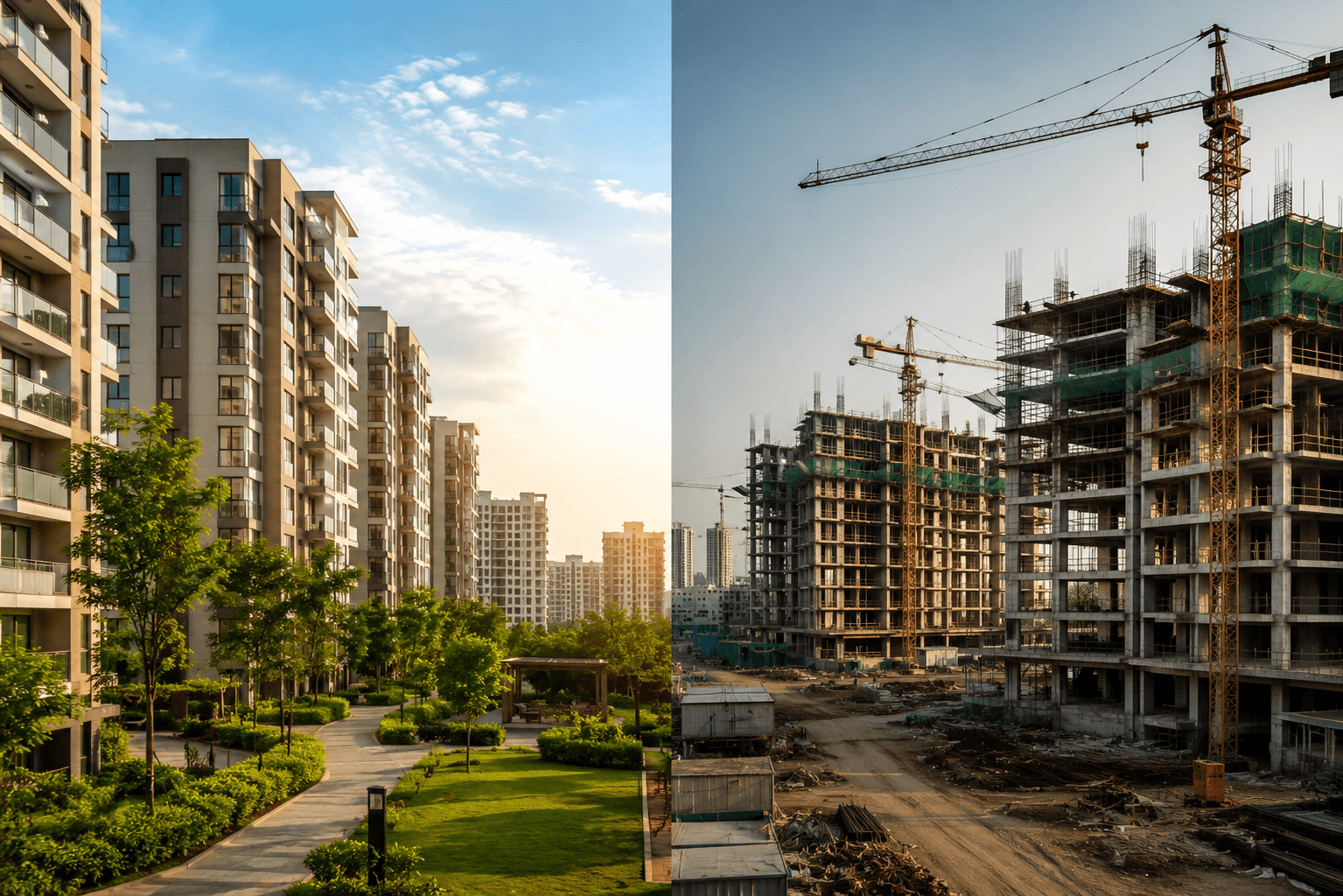
Ready-to-Move vs Under-Construction Property is one of the biggest decisions homebuyers and investors face before purchasing real estate. Buying a property is a significant financial commitment, and choosing between a ready-to-move home and an under-construction project depends on your budget, investment goals, timeline, and risk tolerance. This guide compares both options, including their advantages, disadvantages, costs, risks, and investment potential, to help you make an informed decision with confidence.
Ready-to-Move vs Under-Construction: Which is Better?
Ready-to-move properties are generally the better choice for buyers who need immediate possession, lower investment risk, and the ability to start earning rental income right away. In contrast, under-construction properties are often preferred by long-term investors because they typically offer lower entry prices and greater potential for capital appreciation. Ultimately, the right choice depends on your budget, financial goals, investment timeline, and risk tolerance.
Over the past few years, India’s real estate market has been more transparent with the introduction of RERA, better financing options, and tighter regulations. As a result, buyers can now find more reliable information to help them compare projects before they invest.
This comprehensive guide will help you understand the distinction between ready-to-move and under-construction properties and enable you to make an informed decision aligning with your needs.
What is a Ready-to-Move Property?
A ready-to-move property is a completed residential or commercial property that has received the required occupancy approvals and is ready for immediate possession.
A Move-in Ready property is a finished home or office space that has received final occupancy approvals from the local jurisdiction. Buyers have the advantage of physically examining the property, finalising the transaction, and moving in soon after registration.
Unlike under-construction projects, ready-to-move-in properties give buyers a clear view of what they are buying. With construction quality and amenities, you can see everything before you invest.
Key Features of Ready-to-Move Properties
- Ready possession on purchase
- Inspect before you buy
- You know what you are getting.
- Utilize existing infrastructure and services
- Developed area
- Quicker rentability
- Lower investment risk
Purchasing a ready-to-move-in property gives assurance, as there are no assumptions about the design, quality of construction, or completion schedules of the project
Advantages of Buying a Ready-to-Move Property
Why Buyers Prefer Ready Homes
1. Immediate Possession
One of the biggest benefits is instant ownership. Buyers who need accommodation immediately do not have to wait for years before moving into their new home.
This makes ready homes ideal for:
- Families relocating
- Working professionals
- NRIs returning to India
- Homebuyers ending their rental agreements
2. No Construction Delay Risk
Construction delays have historically affected many projects across different cities. Although RERA has improved accountability, delays can still occur because of labor shortages, regulatory approvals, material costs, or unforeseen circumstances. A ready property eliminates this uncertainty.
3. What You See is What You Buy When buying
A finished product, buyers can check on: Apartment size, Room dimensions, quality of construction, daylight ventilation, view from the balcony, common areas, parking, utilities, clubhouse, alarm systems. This visibility greatly minimizes the risk of buying.
4. Immediate Rental Income
A ready-to-move-in property allows the investors to generate rental income right away. There is no need to wait years for the project to be completed, as rental returns will start immediately upon possession, thus enhancing cash flow and lowering the overall cost of holding.
5. Established Social Infrastructure
Most of the ready projects are located in developed areas that have: Schools Hospitals Shopping Malls. Metro connectivities Restaurants Banks Parks Public Transport This is more suitable for homes with a family or working adults.
6. Streamlined Home Loan Assessment
In general, banks feel more comfortable lending on a finished home, as the risk of construction has been removed. Loan approval may also be quicker because the property already exists
Disadvantages of Ready-to-Move Properties
While ready-to-move properties offer many advantages, they also come with a few limitations that buyers should consider before making a decision.
Higher Purchase Price
Ready possession houses tend to be more expensive than those still under construction in the same area.
The premium reflects:
- Construction completion
- Existing infrastructure
- Instant usability
- Reduced risk of investment
- Limited Inventory
Popular developments are usually sold out after completion of construction. However, buyers have limited options in terms of:
- The Floor you want to be on
- Facing
- Layout
- Building/ Tower selection
Who Should Buy Ready-to-Move?
Best For
- First-time homebuyers
- Families needing immediate possession
- NRIs relocating to India
- Rental income investors
- Buyers who prefer lower investment risk
Not Ideal For
- Buyers with a limited budget
- Investors seeking maximum appreciation
- Buyers comfortable waiting 3–5 years
What is an Under-Construction Property?
An under-construction property is a project that is still being built and will be delivered to buyers on a future possession date. An under-construction property is a residential or commercial project in its development phase, and final possession has not been granted yet. Buyers buy these units at various stages of building, from the first launch to near completion. Developers usually release many payment plans linked to construction stages and provide the flexibility to the buyers to make payments over time.
Advantages of Buying an Under-Construction Property
- Lower upfront cost
- Among the buyers who opt for under-construction properties, the main reason is the cost factor.
- Launch prices tend to be lower than prices for completed projects in the same area.
- This allows buyers to access prime locations at a fraction of the cost.
- Higher Appreciation Potential
According to multiple Indian real estate market reports, under-construction projects in high-growth micro-markets have historically delivered around 15–30% price appreciation between launch and possession. However, actual returns vary based on the developer’s reputation, infrastructure development, market conditions, and project location.
Property values have a tendency to rise as the building is built and surrounding infrastructure is established.
Contributors to appreciation are:
- Your home
- Your neighbors
- Your neighborhood.
- Metro expansion
- New highways
- Business districts
- Schools
- Commercial developments
- Improved connectivity
This slow appreciation is often to the advantage of long-term investors as well.
1. Flexible Payment Plans
A few developers also provide enticing payment plans like:
- Construction-linked plans
- Down payment plans are also available
- Flexible payment plans offered
- Linked to possession plans
This allows buyers to better plan their finances.
2. Wider Choice
Early-bird buyers get to enjoy a wider selection of:-
- Floor level
- Corner apartments
- Park-facing units
- Superior views
- Preferred tower
- Larger balconies
These choices might not be existent any more when the project is finished.
3. Modern Design and Amenities
Newly started housing estate developments are increasingly incorporating:
- Smart home features
- Common areas powered by solar energy
- Green construction
- Security AI-enabled
- Charge EV infrastructure
- Centers for wellness
- Contemporary clubhouses
- Specific work areas
These are the features that today’s home buyers are looking for when shopping for future-ready homes.
4. Customization Opportunities
Depending on the stage of construction, the developer allows the buyer to make the following customizations:
- Flooring
- Modular Kitchens
- Wardrobes
- Wall finishes
- Fittings Electrical
- Fittings Bath and Kitchen
Such personalization may not be possible in finished properties.
Disadvantages of Under-Construction Properties
1. Delays in possession of property
- Possession Delays
- Possession Delays!
- Despite stricter rules, delays are still among the biggest worries.
Some of the possible causes are:
- Shortage of material
- Labor troubles
- Regulatory approvals
- Weather Conditions
- Financial restraints
Although RERA offers legal protection, buyers need to assess the developer’s history of delivery in the past before they invest.
2. Market Risk
Economic conditions can influence property values during construction.
Factors include:
- Interest rates
- Inflation
- Demand fluctuations
- Government policies
Investors should consider long-term market fundamentals instead of short-term price movements.
3. Construction Quality Uncertainty
Since the project is incomplete, buyers cannot inspect the finished apartment.
Instead, they rely on:
- Sample flats
- Brochures
- Developer commitments
- Project specifications
Choosing a reputable developer significantly reduces this risk.
4. EMI and Rent Overlap
Many buyers continue paying rent while simultaneously servicing home loan EMIs during construction.
This increases the financial burden until possession is received.
Who Should Buy an Under-Construction Property?
Best For
- Long-term investors
- Buyers with limited budgets
- Young professionals
- Buyers seeking appreciation
- Investors comfortable waiting
Not Ideal For
- Buyers needing immediate possession
- People avoiding project delays
- Buyers wanting instant rental income
Ready-to-Move vs Under-Construction Properties: Quick Comparison
| Feature | Ready-to-Move | Under-Construction |
| Possession | Immediate | Future date |
| Price | Usually higher | Usually lower |
| Investment Risk | Lower | Moderate |
| Appreciation Potential | Moderate | Higher (location dependent) |
| Rental Income | Immediate | After possession |
| Physical Inspection | Yes | Limited |
| Construction Delay | No | Possible |
| Home Loan | Easier | Depends on project approval |
| Payment | Full payment | Stage-wise payment |
| Customization | Limited | Possible in early stages |
Which Property is Best for Different Buyers?
| Buyer Type | Better Choice |
| First-Time Homebuyer | Ready-to-Move |
| End User | Ready-to-Move |
| Investor | Under-Construction |
| Rental Income | Ready-to-Move |
| Long-Term Appreciation | Under-Construction |
| Low Budget Buyer | Under-Construction |
| Low Risk Buyer | Ready-to-Move |
Which Property Offers Better Value?
Ready-to-move properties provide better value for buyers seeking immediate occupancy, stable rental income, and lower risk. Under-construction properties generally offer better value for investors looking for lower purchase prices and higher long-term appreciation.
The answer depends entirely on your objective.
If your priority is immediate occupancy, stable rental income, and minimal risk, a ready-to-move property is often the more suitable option.
If your goal is long-term capital appreciation, lower entry cost, and investment growth, an under-construction property may provide better opportunities, provided you choose a reliable developer with a strong delivery track record.
Expert Insight from KMA Global Properties:
Real estate advisors generally recommend ready-to-move properties for end users who prioritize certainty, immediate occupancy, and rental income. Under-construction projects are often better suited to investors with a longer investment horizon who can wait for potential capital appreciation.
Checklist Before Buying Any Property
- Verify RERA registration
- Check Occupancy Certificate (OC)
- Verify Completion Certificate (CC)
- Review developer’s delivery history
- Confirm legal title
- Check encumbrance status
- Compare nearby property prices
- Understand loan eligibility
Frequently Asked Questions (FAQs)
- What is better: a ready-built property or a property under construction?
It depends on what your objectives are. If you want to take possession immediately and do not want to bear the risks associated with construction, a ready-to-move-in property is a better option. If your focus is on lower entry prices and longer-term upside, an under-construction property may offer better value.
- Is Purchasing an Under-Construction Property in India Risky?
Yes, you can say that proving the project under RERA and the builder having a good track record will make it safe to buy an under-construction property. Check approvals, project status, and delivery record, and then only invest in RERA projects.
- Why Under-construction Properties Are Usually Cheaper?
Developers sometimes introduce projects with low prices to attract buyers (early birds) and to raise capital for construction. As a rule of thumb, prices rise with the developer’s progress and demand.
- Is it possible to obtain a home loan for an under-construction property?
Yes, Home loans for RERA-registered under-construction projects are offered by most banks and financial institutions. Loan sanction will be based on the legality of the project, the reputation of the developer, and your eligibility.
- What are the risks involved in buying an under-construction home?
The major risk factors include a delay in possession, changes in the market rates, construction quality issues, and the financial strain of paying rent and equated monthly installments (EMIs) until possession.
- What are the benefits of purchasing a ready-to-move-in property?
Immediate possession. The ready-to-move-in property gives immediate possession, as there is no construction delay; you don’t have to wait to take possession. The actual property can be inspected before making a purchase. Rent can be earned instantly over the ready-to-move-in property. Access to established infrastructure.
- Are ready-to-move-in flats costlier?
Yes, ready-to-move-in homes are more expensive owing to the fact that they have construction is complete, possession is immediate, and buyers are exposed to a lower risk as compared to projects that are under construction.
- Am I allowed to modify my house within an under-construction project?
In many cases, yes. Certain developers allow buyers to make certain customization choices for flooring, kitchen layouts, fittings, wall finishes, and other interior components if you buy early in the building process.
- How do I check if an under-construction project is REAL or NOT?
Check the project’s RERA registration details, legal approvals, past projects of the developer, the pace at which the project is being constructed, and also read the builder-buyer agreement twice before deciding.
- Should first-time homebuyers get a ready-to-move property?
For many first-time buyers, a ready-to-move property may be the practical choice, as it comes with immediate occupancy, more transparency and fewer unknowns in the buying process.
Final Takeaway
The choice between a ready and pre-launch property is not that of a one-size-fits-all answer: It depends on what suits your financial goals, lifestyle, and your investment time horizon better.
If you are looking at lower risk, ready possession, well-developed infrastructure, and you want to start earning rent immediately, then a ready-to-move property is your option. But if you are willing to wait and want a lower upfront cost, more flexible payment options, and greater potential for long-term appreciation, an under-construction property might be a better value.
Always assess the location of the property, verify all the legal documents, check the developer’s track record, RERA registration, and your financial strength before you take a decision. Today’s informed decision can save you from costly regrets and enhance your return on investment in real estate.