


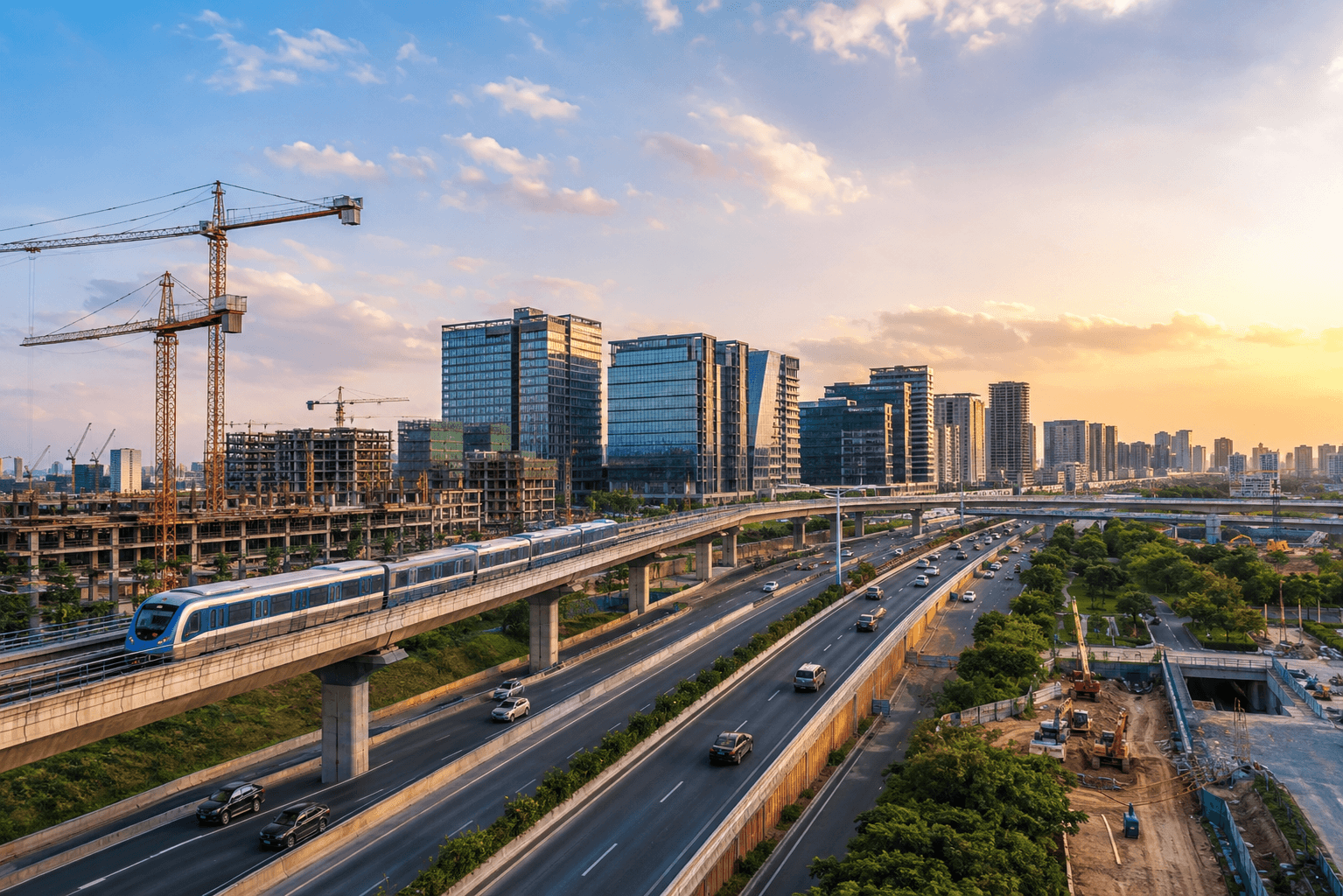
Gurgaon stopped being “a satellite of Delhi” a long time ago. It runs on a corporate base, a growing luxury housing segment, and a steady pipeline of public infrastructure spending, but infrastructure is also the part of the pitch that gets talked about the loosest. Every new road announcement gets called “game-changing” in a brochure, whether or not it actually is. This guide separates funded, under-construction work from proposals still waiting on approvals and looks at what each realistically means for property prices.
Methodology note: This guide is based on publicly announced infrastructure projects, government agency updates, construction progress reports, and officially available project information. Timelines can shift as projects move forward.
Quick Answer
The Gurgaon infrastructure projects most likely to move property prices between now and 2027–2035 are the Gurgaon Metro expansion (28 km, 27 stations, targeted completion around 2027), Global City Gurgaon (a 1,000+ acre township with Phase 1 due December 2026 and full build-out by 2035), the already-operational Dwarka Expressway, and ongoing upgrades along SPR and Golf Course Extension Road. The projects that actually move prices are the ones with confirmed funding, visible construction, and realistic timelines, not the ones that simply read well in a press release.
At a Glance: Active Infrastructure Projects
| Project | Status | Areas Likely to Benefit | Time Horizon |
| Dwarka Expressway | Operational/ongoing | Sectors 102–113, nearby areas | Short–medium term |
| Gurgaon Metro | Under construction | Sectors 45–48, 4, 5, 9, 10 | Medium term |
| Global City | Phase 1 underway | Sectors 36–37B | Long term |
| SPR | Ongoing upgrades | SPR corridor | Medium term |
| Golf Course Extension Road | Ongoing improvements | Adjacent sectors | Medium term |
Why Infrastructure Actually Moves Property Prices
Connectivity changes three things buyers and tenants care about directly: how long the commute is, how easily they can reach jobs and amenities, and how much daily friction is involved in simply living somewhere. When a road, metro line, or planned business district removes that friction, demand shows up, often before the project is even finished, because buyers and investors price in the expected improvement ahead of completion.
The pattern generally plays out in this order:
- Reduced travel time to major employment hubs
- Rising rental demand as commute-sensitive tenants move in
- More developer activity and new project launches nearby
- Stronger social infrastructure, schools, hospitals, retail, following residential growth
- Long-run capital appreciation, concentrated most heavily in the years just before and just after completion
That last point is the timing lesson worth remembering: buyers who enter a corridor while infrastructure is still under construction, not after it’s finished and already priced in, tend to capture more of the upside.
1. Dwarka Expressway — Still the Biggest Growth Corridor
Quick facts: 8-lane, largely elevated corridor · connects Delhi and Gurgaon directly to IGI Airport · anchors the Global City project · status: operational/ongoing
This remains the single most-discussed infrastructure project in the region for a reason: it has materially cut travel time between the two cities and opened up sectors that were commercially unviable a decade ago. It provides direct access to IGI Airport via a previously congested route and continues to attract both residential launches and commercial development along its length.
Investment impact: properties along already-completed stretches have captured most of their obvious appreciation. Sectors near the still-developing portions, particularly around the Global City site, likely have more room to run as the surrounding infrastructure catches up.
2. Gurgaon Metro Expansion — Funded, Under Construction, on a Real Timeline
Quick facts: ~28 km corridor · 27 elevated stations · Millennium City Centre to Cyber City · Phase 1 (to ~Sector 9) active, piling/pillar work underway at Sector 45 and Subhash Chowk · Phase 2 (Sector 9 to Cyber City) went to tender early 2026 · targeted completion ~2027
Unlike infrastructure announcements that stay on paper for years, this one is genuinely under construction. Groundbreaking happened in late 2025/early 2026, and active work is visible in the field, not just on planning documents. The line also includes a dedicated 1.85 km spur connecting Basai Village directly to the Dwarka Expressway, plus interchange access with the existing Delhi Metro Yellow Line and Rapid Metro.
Areas set to benefit most: Sectors 45, 46, 47, and 48, Hero Honda Chowk, Subhash Chowk, Palam Vihar, Udyog Vihar, and older, historically underserved sectors like 4, 5, 9, and 10.
A second, separate corridor connecting Golf Course Extension Road, SPR, the Global City site, and onward to Manesar has also been proposed. It’s worth watching, but it’s still early in planning and tendering, not yet at the same construction stage as the Millennium City Centre–Cyber City line.
Why this matters for pricing: metro-adjacent sectors across NCR have consistently shown stronger occupancy and appreciation once lines go operational, largely because reduced commute friction expands the realistic buyer pool for a location, not because of speculation.
3. Global City Gurgaon — The Largest Single Bet on Future Growth
Quick facts: 1,000+ acre mixed-use township · developer: HSIIDC (Haryana State Industrial & Infrastructure Development Corporation) · Sectors 36, 36B, 37, 37B/D · total planned investment ~₹1 lakh crore · Phase 1 (587 acres, ₹940 crore) targeted for December 2026 · full completion targeted 2035 · ~20 minutes from IGI Airport, 20–30 minutes from Cyber City
This is the most ambitious individual project on this list, sitting directly on the Dwarka Expressway. It’s planned to include Grade-A office space, residential towers, retail, hospitality, and public infrastructure, with an internal transit system planned for later phases.
What this means for buyers: this is a genuine long-term catalyst, but the emphasis has to stay on the long term; the full build-out extends into the mid-2030s. Sectors immediately surrounding it are likely to see steady, staged demand growth as successive phases are completed, rather than one sudden price jump.
4. Southern Peripheral Road (SPR)
Quick facts: Connects Golf Course Extension Road and NH-48, roughly parallel to the Delhi–Jaipur highway · status: ongoing upgrades
SPR has moved from an underdeveloped stretch to one of Gurgaon’s more active mixed-use corridors over the past several years, with strong east-west connectivity linking two major growth zones, a growing mix of luxury residential, Grade-A office space, and retail, plus continued road upgrades supporting further expansion. It would also directly benefit from the proposed second metro line, if and when that advances past planning.
What sets this corridor apart is that it isn’t dependent on any single infrastructure project succeeding; it draws simultaneously from Dwarka Expressway proximity, metro plans, and its own commercial growth.
5. Golf Course Extension Road — Infrastructure Catching Up to Demand
Quick facts: ongoing road widening and junction improvements · status: infrastructure catching up to already-strong residential demand
This corridor already has strong residential demand; what’s changed more recently is the physical infrastructure supporting it, road widening, better traffic management, and expanding commercial development around it, alongside continued growth in schools, hospitals, and retail supporting the existing residential base.
The story here is less about one flagship project and more about steady civic upgrades catching up to demand that already existed, which tends to support price stability more than dramatic short-term appreciation.
6. Delhi–Mumbai Expressway Connectivity
Gurgaon’s link to the Delhi–Mumbai Expressway strengthens its position as a logistics and commercial hub at a regional, not just city, level. This matters more for commercial and industrial property than for typical residential buyers, but it carries a secondary effect: better regional connectivity tends to draw more corporate investment into Gurgaon generally, which indirectly supports residential demand near business districts.
7. Everyday Civic Upgrades — Less Visible, Still Meaningful
Beyond the headline projects, ongoing civic improvements quietly support property values over time:
- Road widening and new flyovers at chronic bottleneck points
- Underpasses reduce at-grade traffic conflicts
- Drainage upgrades, particularly relevant given the region’s monsoon flooding history
- Modernised traffic signal and management systems
- Utility upgrades supporting new residential density
These rarely make headlines the way an expressway or metro line does. But consistent civic investment is often what determines whether a corridor’s appreciation actually holds up over a decade, rather than spiking and then stalling.
Which Areas Stand to Benefit Most
| Corridor | Primary Driver | Timeline |
| Dwarka Expressway sectors | Expressway + Global City proximity | Ongoing, largely functional |
| Southern Peripheral Road (SPR) | Road upgrades + proposed metro | Ongoing |
| Golf Course Extension Road | Road widening, commercial growth | Ongoing |
| Sectors near Global City | Township development (Phase 1) | Phase 1: Dec 2026; full build-out: 2035 |
| Old Gurgaon (Sectors 4, 5, 9, 10) | New metro corridor | Construction underway; targeted ~2027 |
| NH-48 growth corridor | Regional + expressway connectivity | Ongoing |
How to Actually Evaluate an Infrastructure Claim
An infrastructure announcement should never be the sole reason to buy. Before treating one as a genuine price driver, check:
- Actual construction status — is groundwork visibly underway, or is this still at the announcement/tender stage?
- Government approvals and funding sources — projects backed by confirmed budgets and named agencies (HSIIDC, GMRL) carry far less risk than proposals still awaiting sanction.
- Realistic completion timelines — treat any “2–3-year” claim for a large infrastructure project with some skepticism; large Indian infrastructure projects routinely run longer than the initial announcement suggests.
- Developer credibility in the surrounding area, independent of the infrastructure story itself.
- Existing social infrastructure — schools, hospitals, and retail that are already operating, not just planned.
- Employment generation potential is tied to the project, not just residential appeal.
- Rental demand already visible in the corridor, as a signal of genuine interest rather than speculation.
- Future supply pipeline — how much new inventory is likely to hit the same corridor before the infrastructure is even complete.
Frequently Asked Questions
Which infrastructure project will influence Gurgaon property prices the most?
Dwarka Expressway remains the single biggest driver historically, given its direct Delhi and airport connectivity. The Gurgaon Metro corridor and Global City are likely to be the two biggest incremental drivers over the next several years, given their scale and current construction status.
Is Southern Peripheral Road a good place to invest right now?
SPR benefits from multiple overlapping growth drivers, road infrastructure, proximity to Golf Course Extension Road, and a proposed second metro line, which make it less dependent on any single project staying on schedule.
Does metro connectivity genuinely add value to a property?
Generally, yes. Areas near metro stations across NCR have consistently shown stronger rental demand and long-term appreciation once lines become operational, primarily because reduced commute time expands the pool of realistic buyers and tenants for those locations.
Is it better to invest before an infrastructure project is completed?
Often, yes. Buyers who enter a corridor while infrastructure is still under construction tend to capture more appreciation than those who wait until completion, when the improvement is already priced in. An earlier entry does carry more execution risk if the project faces delays, though.
How long will Global City actually take to complete?
Phase 1 (587 acres) is targeted for completion by December 2026, but the full 1,000+ acre township is planned over a much longer horizon, with full completion targeted around 2035. Treat it as a long-term catalyst, not a short-term trigger.
What’s the biggest risk in buying based on an infrastructure story?
Timeline slippage. Large infrastructure projects in India frequently take longer than initially announced, and buying purely on the promise of a still-unbuilt project, without checking actual construction status and funding, is one of the more common ways investors end up disappointed with their holding-period returns.
Should I buy based only on an upcoming infrastructure project?
No. Weigh infrastructure alongside builder reputation, approvals, pricing, the supply pipeline, and actual end-user demand before deciding.
Final Thoughts
Infrastructure remains one of the strongest long-term drivers of real estate appreciation in this market, and the current pipeline, the new metro corridor, Global City, continued Dwarka Expressway development, and steady upgrades along SPR and Golf Course Extension Road, is genuinely substantial, not just marketing language.
But the projects that actually move prices are the ones with confirmed funding, visible construction progress, and realistic timelines, not the ones that simply sound impressive in a press release. Before treating any announcement as a reason to buy, verify its current construction status, funding source, and realistic completion window; that distinction is usually what separates a well-timed long-term investment from one that spends years waiting on a promise.
About This Guide
This guide was compiled by the KMA Global Property Research Team using publicly announced infrastructure updates, government agency information (including HSIIDC and GMRL project data), construction progress reports, and officially available project details reviewed in August 2026. Timelines for projects like the Gurgaon Metro and Global City are as currently announced and can shift as work progresses; always check the latest status before treating any timeline as fixed.
Disclaimer: Infrastructure timelines and project scopes are subject to change based on funding, approvals, and execution progress. This article is for informational purposes only and does not constitute investment or financial advice. Past infrastructure-led appreciation does not guarantee future returns, and buyers should independently verify current project status before making a purchase decision.
Want to know which specific sectors near an active project actually make sense for your budget? The KMA Global Property team can walk you through the current shortlist.